A berry that dyes the forest blue
Walk a Scandinavian pine forest in late July and the understorey answers in blue. Wild bilberry — Vaccinium myrtillus, the Nordic blåbär — sits low under the moss, small enough to miss until your fingers come back stained. Cut one open and the flesh is dark all the way through. That is not marketing poetry; it is pigment chemistry. Cultivated highbush blueberries often keep their anthocyanins in the peel. Bilberry packs them into the pulp as well — which is why a handful leaves your tongue purple for hours, and why extract makers still start here when they want a serious anthocyanin story.
Carl von Linné noticed the same plant in 1749: freshly picked bilberries taste good; dried, they fill and mash; they dye purple and red. Three centuries later, laboratories are still returning to the same species — not for folklore alone, but because human trials and cell work keep producing measurable signals around screen-related eye fatigue, NF-κB-related inflammatory mediators, and post-meal glucose curves. Bilberry extract, Nordic wild bilberry, and everyday bilberry supplements sit in that long conversation between forest and paper.
What follows is written for a buyer who wants the entrance to feel true — and the evidence, afterwards, to stay honest.
Why it matters to you
If you spend your day on a screen, the question people actually ask is simple: is there human research on bilberry and eye fatigue under visual load? Short answer: yes — randomised trials in VDT workers have reported objective and subjective changes after weeks of bilberry extract, discussed in detail below. That is research in healthy adults under defined loads, not a promise that any capsule will fix your eyes.
If inflammation language interests you, the published trail runs through NF-κB and the p65 subunit: cell studies show berry anthocyanins can reduce p65’s move into the nucleus; human trials with purified anthocyanins or bilberry juice have watched circulating mediators such as IL-8, CRP and IL-6 move — sometimes in mixed directions. Again: discussion of papers, not a disease claim.
If blood-sugar curiosity brought you here, small controlled studies (including an acute challenge in diet-managed type 2 diabetes) have reported lower incremental glucose responses after standardised bilberry extract. Limits matter as much as results — sample size, dose, duration — and we spell them out.
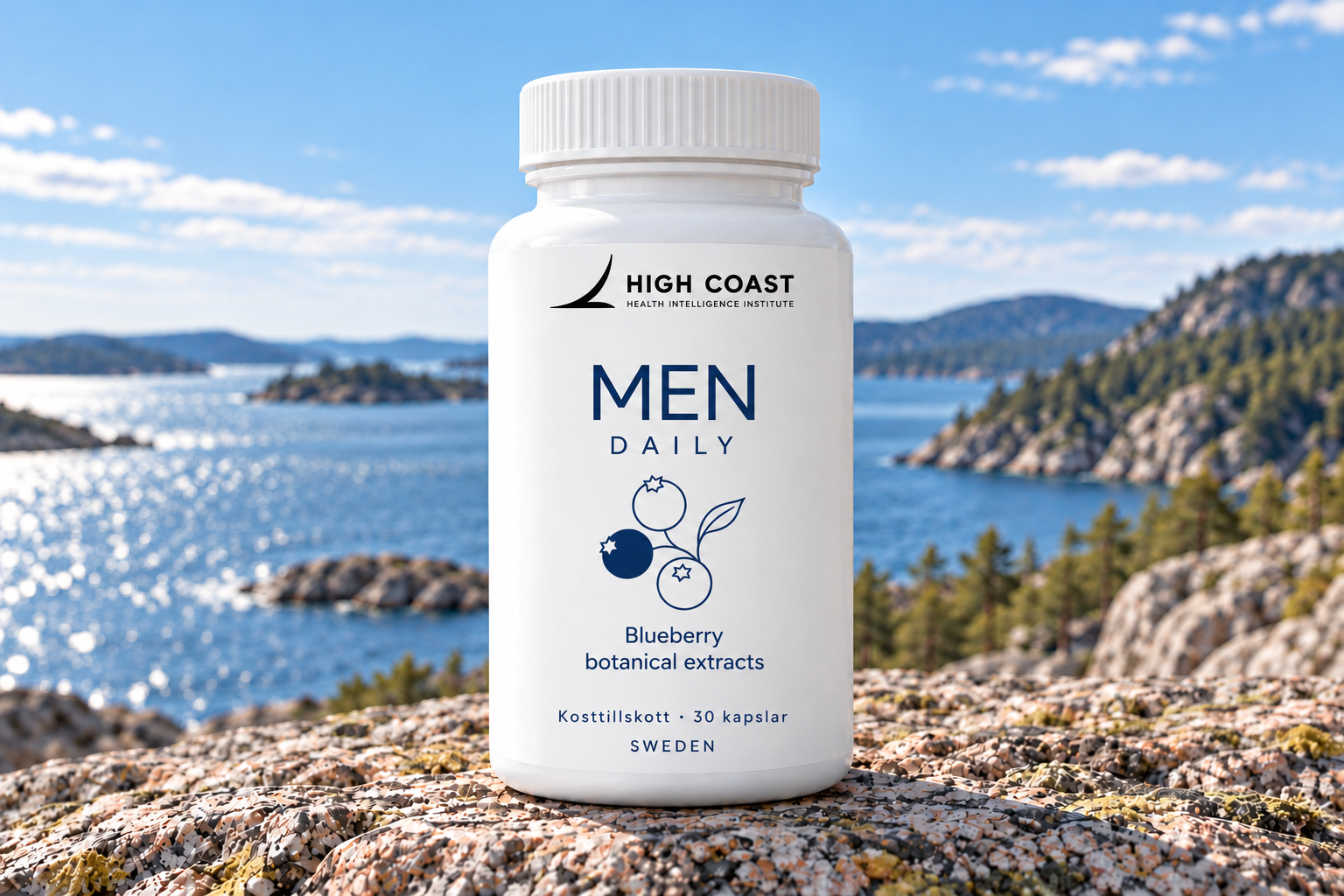
On this shelf you will find that story in different forms: Wild Bilberry Anthocyanin™ for a clear extract focus, the SideraClear™ line for blueberry–bilberry-led formats, and MEN / DAILY, which brings blueberry fruit extract together with zinc and niacin (nutrients that carry their own authorised EU Register wording). Browse the products above; use the research sections below as the proof layer — not as a substitute for the label.
Study discussion: anthocyanins, NF-κB and p65
Anthocyanins from bilberry and related berries are often discussed for an anti-inflammatory signalling angle in the published literature: in cell systems they can blunt activation of the transcription factor NF-κB, including reduced nuclear movement of the p65 subunit. Human trials then ask whether circulating NF-κB–related mediators change when people ingest purified anthocyanins or bilberry juice. Below we summarise key papers — cell versus human — without product-effect promises.
Karlsen et al., 2007 — Medox anthocyanins and NF-κB-related mediators in humans
Population: 120 healthy adults aged 40–74 years.
Design / dose / duration: parallel, placebo-controlled; Medox (purified anthocyanins from bilberry and blackcurrant) 300 mg/day for 3 weeks; plus monocyte assays with the same anthocyanin material.
Result: in cultured monocytes, the anthocyanins suppressed LPS-induced NF-κB activation (with reduced p65 DNA binding in the reported cell readouts). In the human arm, changes in several NF-κB-related plasma mediators (including IL-8, RANTES and IFN-α) differed from placebo, with larger decreases from baseline in the Medox group.
Limitation: healthy volunteers and circulating mediators only; Medox is a mixed bilberry/blackcurrant anthocyanin preparation, not identical to every bilberry extract.9
Lee et al., 2014 — berry anthocyanins and p65 nuclear translocation (cells)
Model: LPS-stimulated RAW 264.7 macrophages.
Exposure: blueberry, blackberry and blackcurrant anthocyanin fractions in vitro (µg/mL range).
Result: pro-inflammatory cytokine readouts fell; LPS-driven NF-κB p65 translocation into the nucleus was markedly attenuated by all three fractions.
Limitation: cell-culture concentrations and an LPS challenge — mechanistic support for the p65 idea, not proof that a dietary capsule dose reproduces the same nuclear effect in vivo.10
Karlsen et al., 2010 — bilberry juice and CRP / IL-6
Population: adults with at least one elevated cardiovascular risk factor (n = 31 juice vs n = 31 water), as enrolled in that trial.
Design / dose / duration: randomised controlled; bilberry juice for 4 weeks versus water.
Result: plasma CRP, IL-6, IL-15 and MIG decreased in the bilberry-juice group; TNF-α unexpectedly increased — a mixed NF-κB-related marker pattern the authors discuss as modulation rather than uniform suppression.
Limitation: juice matrix (not a standardised anthocyanin capsule); mixed TNF-α direction; risk-factor volunteers as defined by the study, not a disease-treatment design.11
Study discussion: screen-related eye fatigue
Ozawa et al., 2015
Population: Japanese office workers aged 20–40 who used VDTs, screened for lower critical flicker fusion (CFF) / near-point accommodation.
Design / dose / duration: randomised, double-blind, placebo-controlled; bilberry extract 480 mg/day for 8 weeks; outcomes before/after an acute VDT load.
Result: the extract group showed a smaller VDT-related drop in CFF and improvements in several subjective eye-fatigue items versus placebo.
Limitation: healthy VDT users under a defined load — not patients with diagnosed eye disease; dose and extract standardisation are study-specific.1
Kosehira et al., 2020
Population: 109 healthy adults 20–60 years.
Design / dose / duration: 12-week RCT; 240 mg/day standardised bilberry extract; ciliary-muscle accommodation after VDT tasks at weeks 0, 4, 8, 12.
Result: post-load accommodation markers favoured the extract group at weeks 8 and 12.
Limitation: again a VDT / near-work model in healthy volunteers; findings do not generalise automatically to other doses, extracts or clinical diagnoses.2
Study discussion: post-meal glucose (including Hoggard)
Hoggard et al. — acute bilberry extract in diet-managed type 2 diabetes
Population: eight men with type 2 diabetes controlled by diet and lifestyle alone.
Design / dose / duration: double-blind crossover; single 0.47 g capsule of standardised bilberry extract (36% anthocyanins, roughly equated by the authors to ~50 g fresh bilberries) or placebo before a polysaccharide drink (~75 g glucose equivalent), with washout.
Result: lower incremental AUC for glucose and for insulin versus placebo after that challenge.
Limitation: very small n; single acute dose; not a long-term glycaemic-control or medication-substitution trial. We keep this paper in view because it is a clear, controlled human signal — and because its limits matter as much as its result.3
Alnajjar et al., 2019
Population: sixteen overweight volunteers.
Design / dose / duration: double-blind crossover; ~3 weeks of 0.47 g-class bilberry extract capsules daily versus placebo; OGTT.
Result: about 20% lower glucose AUC versus placebo, without a matching insulin AUC change.
Limitation: short intervention and modest sample; mechanism suggested (digestion/absorption) was partly inferred from in-vitro work.4
Label law vs research discussion
On-hold botanicals: EU lists still carry pending Article 13 bilberry wordings (examples: ID 2001 eye-health / antioxidant–vascular theme; ID 2050 eye health and function / antioxidant and venous support). Pending ≠ authorised Register claim.5
Authorised nutrients in-category: where a product such as MEN / DAILY also provides zinc or niacin, the only fully authorised health phrasing for those nutrients is the EU Register text (zinc: maintenance of normal serum testosterone; niacin: normal energy-yielding metabolism; reduction of tiredness and fatigue).6,7 That wording attaches to the nutrient, not to bilberry anthocyanins.
Study discussion: the night-vision myth (null evidence in healthy eyes)
Canter & Ernst (2004) systematically reviewed placebo-controlled trials of bilberry anthocyanosides for night vision and did not find reliable benefit in healthy eyes; WWII jam stories remain folklore / possible radar cover in secondary accounts.8,12 We give this null literature the same open treatment as the positive VDT, NF-κB and glycaemia papers: cite it, state what was tested, and do not oversell either side.
Short FAQ
Are you claiming these products reproduce the trial results?
No. We discuss research. Products are labelled for composition and for any authorised nutrient claims that apply.
Is bilberry the same as blueberry?
No. Bilberry is typically wild Vaccinium myrtillus; culinary blueberry is usually cultivated highbush. Pigment distribution in the fruit differs — bilberry flesh is often blue throughout.
What about night vision?
Popular story; weak evidence in healthy eyes per systematic review — stated plainly.
Where do I start on this page?
Products above for the format you want; long research sections below for the evidence trail; Linnaeus still gets the last poetic word in the quote block.
Sources
1 Ozawa Y. et al. J. Nutr. Health Aging 19:548–554 (2015). doi:10.1007/s12603-014-0573-6
2 Kosehira M. et al. Nutrients (2020). PMC7146147
3 Hoggard N. et al. PMC4153034
4 Alnajjar M. et al. J. Funct. Foods (2019). doi:10.1016/j.jff.2019.103597
5 EU on-hold botanical claim lists — bilberry IDs 2001, 2050.
6 EFSA Journal 2010;8(10):1819. doi:10.2903/j.efsa.2010.1819
7 EFSA Journal 2010;8(10):1757. doi:10.2903/j.efsa.2010.1757
8 Canter & Ernst, Surv. Ophthalmol. (2004). doi:10.1016/j.survophthal.2003.10.006
9 Karlsen A. et al. J. Nutr. 137:1951–1954 (2007). doi:10.1093/jn/137.8.1951
10 Lee S.G. et al. J. Nutr. Biochem. 25:404–411 (2014). doi:10.1016/j.jnutbio.2013.12.001
11 Karlsen A. et al. Eur. J. Nutr. 49:345–355 (2010). doi:10.1007/s00394-010-0092-0
12 NCCIH bilberry fact sheet. nccih.nih.gov/health/bilberry