
Introduction
The microbiome is often discussed as if it belongs mainly to the gut. In reality, the human body contains several local microbial ecosystems. The mouth has one. The vaginal environment has one. The skin and external intimate area have their own barrier ecology.
These environments are not the same.
The oral cavity is shaped by saliva, teeth, gums, mucosa, diet, oral hygiene and microbial biofilms. The vaginal environment is strongly influenced by pH, lactobacilli, hormones, moisture and epithelial biology. The external intimate area is different again: it is primarily a sensitive skin and barrier environment.
For product development, this distinction matters.
A mouth rinse, an external intimate cream and a vaginal insert are not interchangeable formats. Each one must be designed for the local biology of the surface where it is used.
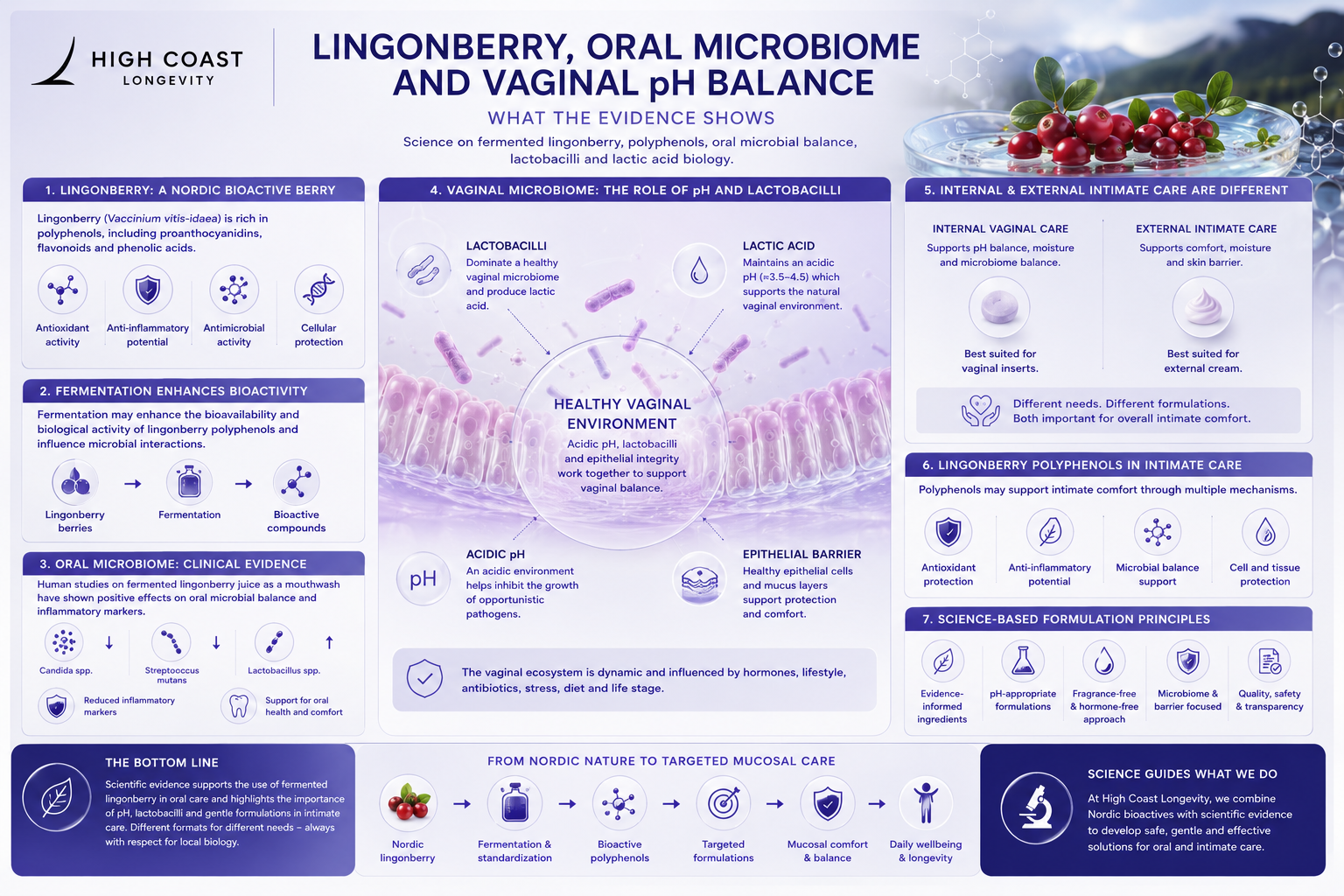
This article reviews the scientific rationale behind lingonberry-based mucosal care, with particular focus on fermented lingonberry research in the oral cavity, lingonberry polyphenols, and the established role of pH, lactic acid and lactobacilli in vaginal microbial balance.
The purpose is not to claim that lingonberry products treat oral or vaginal infections. They do not. The purpose is to explain why lingonberry, fermentation, polyphenols, pH support and gentle barrier-focused formulation are scientifically relevant areas for oral and intimate care development.
1. Mucosal surfaces are biological ecosystems
Mucosal surfaces are living interfaces between the body and the external environment. They are not sterile. They contain microbial communities, secretions, immune signals and epithelial cells.
A healthy mucosal surface is not defined by the absence of microbes. It is defined by balance.
In the mouth, that balance includes saliva flow, oral hygiene, biofilm composition, mucosal integrity and the relationship between bacterial and fungal organisms.
In the vaginal environment, balance is often associated with lactobacilli, acidic pH and epithelial conditions that support the normal vaginal ecosystem.
Because these surfaces are sensitive, aggressive products can be counterproductive. Strong antiseptics, unnecessary perfume, harsh surfactants or poorly matched pH may disturb comfort or barrier function.
A serious mucosal-care product should therefore be built around three principles:
-
The local biology of the surface.
-
A delivery form appropriate for that surface.
-
A conservative formulation that avoids unnecessary irritation.
This is the basic framework behind mucosal microbiome-oriented product development.
2. Why lingonberry is scientifically interesting
Lingonberry, Vaccinium vitis-idaea, is a Nordic berry naturally rich in phenolic compounds. These include proanthocyanidins, flavonoids, anthocyanins and phenolic acids.
Phenolic compounds are interesting because they may interact with oxidative stress, microbial adhesion, inflammatory pathways and cellular protection mechanisms.
A 2024 review of lingonberry fruit phenolic bioactivities describes antimicrobial, anti-inflammatory, antiproteolytic and antioxidant effects in the existing experimental and human research literature. The same review also emphasizes an important limitation: many studies are based on in vitro systems, animal models or mixed berry preparations, making it difficult to isolate the effects of lingonberry alone in humans.
That limitation matters.
Lingonberry is promising, but the evidence is not equally strong for every use case. The strongest direct human evidence relevant to mucosal-care formulation is currently found in the oral cavity, where fermented lingonberry juice has been studied as a mouthwash.
3. Fermented lingonberry juice and the oral cavity
The oral cavity is a logical place to study fermented lingonberry because it is directly accessible and because microbial changes can be measured.
A clinical pilot study published in Microorganisms investigated fermented lingonberry juice as a mouthwash in adults. The researchers studied oral microbial markers including Streptococcus mutans, Candida and lactobacilli, along with inflammatory markers in the oral cavity.
The study was small, but it provided an early clinical basis for the idea that fermented lingonberry preparations may influence oral microbial balance and inflammation-related markers.
A later human intervention study evaluated longer use of fermented lingonberry juice in the oral cavity. The study examined typical oral microbes, including Candida, S. mutans and lactobacilli, and explored potential effects related to caries, inflammation and periodontal health.
These studies do not prove that fermented lingonberry mouthwash is a treatment for oral disease.
They do, however, support a cautious and scientifically reasonable conclusion:
Fermented lingonberry is a relevant botanical candidate for oral microbiome-oriented formulation.
That is very different from claiming that lingonberry “cures” oral fungal infection or replaces medical treatment.
4. Why an oral balance rinse is different from a conventional mouthwash
Many conventional mouthwashes are built around a strong sensory effect: alcohol, intense flavoring, cooling sensation or broad antimicrobial action.
That approach may be useful in some contexts, but it is not the only model for oral care.
A microbiome-oriented oral rinse has a different aim. It is not designed to sterilize the mouth. The mouth should not be sterile. It is designed to support a more balanced oral environment while also being tolerable for repeated use.
This makes several formulation choices important:
-
alcohol-free base
-
no added sugar
-
acceptable acidity
-
comfortable taste profile
-
compatibility with oral mucosa
-
microbial safety
-
consistency between batches
For a lingonberry-based oral rinse, fermentation and polyphenol content are especially relevant. The oral evidence does not support exaggerated medical claims, but it does support the rationale for a fermented lingonberry oral-care product focused on freshness, mucosal comfort and oral microbial balance.
5. The vaginal microbiome is different from the oral microbiome
The vaginal microbiome should not be treated as simply another version of the oral microbiome.
It has its own biology.
In many reproductive-age women, the vaginal microbiome is commonly associated with dominance of lactobacilli and an acidic pH. Lactobacilli contribute to this acidic environment partly through lactic acid production.
Direct in vivo measurements have supported the relationship between lactobacilli, lactic acid and vaginal pH. Research has also shown that the vaginal microbiota changes across the lifespan and is influenced by hormones, sexual activity, antibiotics, immune status and other factors.
This means vaginal product development should be careful.
A product designed for the vaginal environment should consider pH, moisture, local compatibility, avoidance of unnecessary irritants and the fact that the vagina is a self-regulating biological system.
The goal should not be to “clean” the vagina in the way one might clean external skin. The goal should be to avoid disruption and, when appropriate, support conditions associated with normal balance.
6. Lactic acid and pH support
The acidic vaginal environment is one of the defining features of vaginal microbial balance. Lactobacilli are closely associated with this environment because they produce lactic acid.
Research has examined the relationship between lactic acid, pH and microbicidal activity in vaginal fluid. The findings support the idea that lactic acid is not simply a marker of acidity, but part of the biological environment associated with vaginal microbial balance.
For formulation, this does not mean that simply adding acid is a complete solution. Vaginal ecology is more complex than pH alone.
However, pH support remains a rational design element in vaginal-use products, provided the product is appropriately formulated, tested and clearly positioned as intimate care rather than medical treatment.
This is why a vaginal-use product designed for intimate balance may reasonably include a lactic acid or lactate-based pH-support system.
7. Internal and external intimate care should be separated
One of the most important product-development principles in intimate care is the separation between internal and external use.
The vaginal environment is internal, mucosal and pH-sensitive.
The external intimate area is skin and barrier tissue. It may be sensitive, but its needs are not identical to the internal vaginal environment.
A vaginal insert and an external cream therefore have different roles.
A vaginal insert should be designed for internal vaginal use. It should dissolve appropriately, be comfortable, be compatible with the vaginal environment and avoid unnecessary fragrance or irritation.
An external intimate cream should be designed for the external intimate area. It should focus on comfort, moisture and skin barrier support. It should not be assumed to be appropriate for internal use.
This distinction is not only regulatory. It is biological.
A serious intimate-care range should make the difference clear.
8. The role of external barrier support
The external intimate area can be affected by dryness, friction, washing habits, clothing, hormonal changes, shaving, sweating and sensitivity to ingredients.
For this area, the most rational product format is a gentle external cream.
A well-designed external intimate cream should generally avoid perfume, strong cooling agents and unnecessary sensitizing ingredients. It should focus on skin-compatible moisturizers, barrier-supporting lipids and a pH profile suitable for sensitive external skin.
Fermented lingonberry can be included as part of a broader Nordic bioactive concept, but the cream should not rely on a single ingredient story. The entire formulation matters.
For external intimate care, the most relevant product goals are:
-
comfort
-
moisture
-
reduced feeling of dryness
-
barrier support
-
tolerability
-
daily usability
These are care-oriented goals, not disease-treatment claims.
9. How lingonberry fits into intimate-care formulation
The scientific evidence for fermented lingonberry is stronger in the oral cavity than in vaginal-use products. This should be stated clearly.
The rationale for lingonberry in intimate care is therefore not the same as the rationale for fermented lingonberry mouth rinse.
For intimate care, the logic is broader:
-
Lingonberry contains phenolic compounds with documented bioactivities in experimental and limited human contexts.
-
Fermentation is relevant to microbiome-oriented formulation.
-
Vaginal balance is closely linked to pH, lactobacilli and moisture.
-
External intimate comfort depends on barrier support and gentle ingredients.
-
Fragrance-free, hormone-free and low-irritation formulation is appropriate for sensitive intimate care.
In other words, lingonberry is one part of the concept. It should be combined with correct product format, pH logic, barrier ingredients and appropriate safety testing.
That is the serious formulation position.
10. Product formats: oral rinse, cream and vaginal insert
The product format determines how the formulation interacts with the body.
Oral rinse
An oral rinse is used briefly in the mouth and then spat out. It must be acceptable in taste, pH and mouthfeel. It should not contain added sugar and should be compatible with repeated use.
The fermented lingonberry oral studies make this format the most directly evidence-supported application of the lingonberry mucosal-care concept.
External intimate cream
An external cream stays on the skin. It must be gentle, non-perfumed and designed for sensitive external tissue. Its main role is comfort, moisture and barrier support.
This format is appropriate for both women and men when clearly labeled for external use only.
Vaginal insert
A vaginal insert is used internally and dissolves after application. It must be designed for vaginal compatibility. A lipid-based insert may support moisture and comfort, while a lactic acid/lactate system may support pH balance.
Because oil-based vaginal products may affect latex condoms or diaphragms, compatibility warnings are important unless specific testing has been performed.
11. What the evidence suggests
The current evidence supports a careful and limited interpretation.
Lingonberry is scientifically interesting because it contains phenolic compounds with documented antimicrobial, antioxidant and anti-inflammatory bioactivities in experimental and human research settings.
Fermented lingonberry juice is particularly relevant in the oral cavity, where it has been studied as a mouthwash in human trials. These studies suggest that fermented lingonberry preparations may influence oral microbial balance, including organisms such as Candida, Streptococcus mutans and lactobacilli.
For the vaginal environment, the strongest evidence does not come from lingonberry itself. It comes from the established biology of vaginal pH, lactobacilli and lactic acid.
A healthy vaginal ecosystem is often associated with lactobacilli dominance and an acidic pH, although the vaginal microbiome is dynamic and influenced by age, hormones, antibiotics, sexual activity, immune status and other factors.
Taken together, the evidence supports three broad conclusions:
-
Fermented lingonberry is a relevant candidate for oral microbiome-oriented care.
-
Vaginal pH and lactobacilli are central concepts in vaginal microbial balance.
-
Mucosal-care formulations should be designed with respect for local biology, not only ingredient trends.
This does not mean that lingonberry should be presented as a treatment for oral or vaginal infections. It means that lingonberry, fermentation, pH support and gentle barrier-focused formulation are scientifically relevant areas for further mucosal-care development.
12. A careful framework for mucosal-care formulation
Mucosal-care products require more precision than ordinary skin or wellness products.
The mouth, the vaginal environment and the external intimate area are biologically different. A formulation designed for one surface should not automatically be assumed to fit another.
A serious formulation framework should consider:
-
the intended surface
-
pH compatibility
-
microbial safety
-
barrier tolerance
-
ingredient restraint
-
avoidance of unnecessary fragrance or irritants
-
appropriate delivery form
-
clear use instructions
The most important principle is local biological compatibility.
For the mouth, this may mean an alcohol-free, sugar-free rinse designed for repeated oral use.
For the external intimate area, this may mean a gentle cream focused on moisture and barrier support.
For the vaginal environment, this may mean an internal format designed around pH, moisture and vaginal compatibility.
The same botanical ingredient can therefore require different formulation strategies depending on where it is used.
13. Conclusion
Lingonberry is a scientifically relevant Nordic berry because of its phenolic compound profile and its emerging role in oral microbiome research.
The strongest direct human evidence is currently found in the oral cavity, where fermented lingonberry juice has been studied as a mouthwash. This supports further interest in fermented lingonberry as part of oral microbiome-oriented care.
The intimate-care rationale is different. It is based less on direct lingonberry trials and more on the established biology of vaginal pH, lactobacilli, lactic acid, moisture and barrier tolerance. This distinction is important.
A credible mucosal-care approach should therefore be evidence-informed rather than overstated.
The scientific foundation is not that one berry solves multiple problems. The foundation is that local mucosal environments can be supported through careful formulation: appropriate pH, gentle ingredients, microbial safety, barrier compatibility and biologically relevant compounds.
That is where lingonberry, fermentation and mucosal microbiome science become interesting — not as a cure, but as part of a more precise and respectful approach to oral and intimate care.
Related High Coast formulations
This article is part of the scientific background for High Coast’s mucosal microbiome formulation work.
LingonBalance Oral™
Fermented lingonberry oral rinse for oral freshness, mucosal comfort and oral microbiome balance.
LingonBalance Intimate Cream™
External intimate cream for comfort, moisture and barrier support.
LingonBalance Vaginal Inserts™
Dissolving vaginal inserts for pH, moisture and intimate microbiome balance.
LingonBalance Intimate Duo™
Combination pack with vaginal inserts and external intimate cream.
References
- Pärnänen P, Niikko S, Lähteenmäki H, Räisänen IT, Tervahartiala T, Sorsa T, Ranki A. Lingonberry (Vaccinium vitis-idaea L.) Fruit Phenolic Bioactivities—A Review of In Vitro and In Vivo Human Studies. Microorganisms. 2024;12(9):1850.
- Pärnänen P, Nikula-Ijäs P, Sorsa T. Antimicrobial and Anti-Inflammatory Lingonberry Mouthwash—A Clinical Pilot Study in the Oral Cavity. Microorganisms. 2019;7(9):331.
- Pärnänen P, Lomu S, Räisänen IT, Tervahartiala T, Sorsa T. Antimicrobial and Anti-Inflammatory Oral Effects of Fermented Lingonberry Juice. Nutrients. 2021.
- O’Hanlon DE, Come RA, Moench TR. Vaginal pH measured in vivo: lactobacilli determine pH and lactic acid concentration. BMC Microbiology. 2019;19:13.
- Łaniewski P, Herbst-Kralovetz MM. Lactobacilli and Their Probiotic Effects in the Vagina of Reproductive Age Women. Microorganisms. 2023;11(3):636.
- O’Hanlon DE, Moench TR, Cone RA. Vaginal pH and Microbicidal Lactic Acid When Lactobacilli Dominate the Microbiota. PLOS ONE. 2013;8(11).